top of page

Introducing the world's most biodegradable baby diaper!
THE PROBLEM
Diapers leave our homes quickly, but not our planet. Each child will use 3,000-5,000 disposable diapers in their lifetime, many of which will outlast their childhood by generations.
.png)
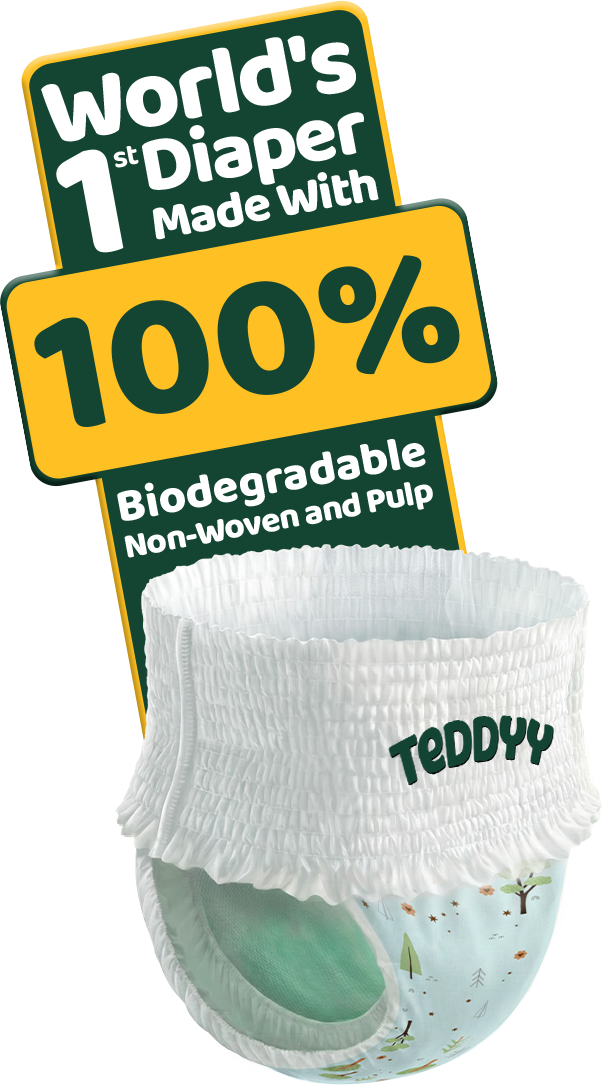
Meet Teddyy Bio–Earth – the world’s first diaper with biodegradable non-woven technology.
SOLUTION
Parents in Dubai are adopting a new class of disposable diapers engineered to safely biodegrade in real-world conditions if they escape into the environment.
Lyfecycle technology Explained


1
2
3
The non-woven body of this diaper is made with Lyfecycle technology, allowing it to safely return to nature after use without compromising on functionality and softness.
If this diaper is exposed to an open environment after use, such as that often found in an unmanaged landfill, its body will transform into a harmless bioavailable wax.
Microbes will consume the wax, returning it to nature within two years without leaving any toxins or microplastics behind.
2
ND

The UAE has the
highest amount of mismanaged plastic waste per capita globally
Source: Plastic Overshoot Day Report 2024, Earth Action

More than
400
million tonnes of plastic is produced globally every year
Source: Beat Plastic Pollution, United Nations
An estimated
11
billion single-use plastic items are consumed annually in the UAE
Source: Plastic Overshoot Day Report 2024, Earth Action


Teddyy Bio–Earth
An eco-conscious solution made with components that safely return to nature, reducing the risk of plastic pollution and helping protect our planet.
.png)
.png)

On average, 4 diapers are used every day for at least 3 years of your baby’s life. That is more than 4300 diapers per baby!
The same garbage truck that collects your food waste often carries your diaper waste too.
If this diaper is exposed to an open environment after use, such as that often found in an unmanaged landfill, the diaper components containing Lyfecycle technology will safely biodegrade leaving behind no toxins or microplastics.

Absorbent Core
45%
diaper weight

75% diaper weight is biodegradable!
Diaper Body
30%
diaper weight
Vegan
Chlorine free
Sulphate free
Pthalates free
Non-toxic
Hypoallergenic
Paediatrician tested
Not Just Good For The Planet, But Also Safe For Your Baby
A product that prioritises your baby’s skin and is gentle on the planet.

Up To 12 Hours High Absorption

Odour Lock

Wetness Indicator

Anti-Rash
Certified. Tested. Patent–backed.
ISO: Medical Devices
Medical Devices Standard Certification ensures quality. It applies to medical device manufacturing.

.png)
ISO: QMS Standard
QMS Standard is a quality management system. It ensures consistent products and services.
WHO GMP Certification ensures product quality. It follows guidelines set by the World Health Organsiation.

Lyfecycle technology is incorporated into the non-woven components of the diaper. Developed and patented in the UK, Lyfecycle technology ensures that plastic will safely return to nature when exposed to the open terrestrial environment. The non-woven is independently tested to meet the BSI PAS 9017 standard published the British Standards Institution.
WHO GMP Certification

CE marking indicates conformity with health, safety, and environmental protections standards. It’s for products sold in the European Economic Area.
CE Marking

The Forest Stewardship Council (FSC) logo shows a product comes from responsibly managed forests, supporting sustainable harvesting, fair labor, and wildlife protection.
FSC MARKING

The U.S. Food and Drug Administration (FDA) logo primarily signifies official government endorsement and regulation of food, drugs, cosmetics, and medical devices.
USFDA STAMP

Witness
Lyfecycle Breakthrough
Technology In Action
Watch how plastic applications made using Lyfecycle technology return to nature in real world conditions through Lyfecycle’s Living Lab experiment.
Leading Minds Of The Planet – Making The Best Diapers For This Planet

Ethically sourced, FSC certified, wood pulp from US


Biodegradable
non-wovens and PE backsheet from Europe


Superior anti-bacterial SAP from Japan

With India’s leading absorbency specialist


Launching first, in Dubai
Our Mission
We can’t solve world problems in one day. But, we can start by making a REAL difference.
Q. Is it safe for the environment?
Yes. Please dispose of the diapers responsibly in the normal way. However, if this diaper is exposed to an open environment after use, such as that often found in an unmanaged landfill, its major components will fully biodegrade with the body (non-woven) undergoing a unique biotransformation process, transforming into an earth-friendly wax, fully biodegrading within 2 years leaving no toxins or microplastics.
Q. How does it safely return to nature?
Exposure to the natural elements of decay - light, heat moisture, and air - will activate the technology in the diaper’s body on land. It will quickly transform into a bioavailable wax that goes on to fully biodegrade within two years. The diaper’s absorbent core is made of cellulose which is a naturally biodegradable material.
Q. Where to read more about this Lyfecycle technology?
Check out and follow Lyfecycle on Instagram to learn more about the tech: https://www.lyfecycle.com/
Frequently Asked Questions
We've compiled the most common questions about Teddyy Bio-Earth.


Teddyy Socials
bottom of page